subscribe to the RSS Feed

Thursday, May 24, 2012

Paper Quilling

Posted by Cindy on May 10, 2012

Classic repost, originally posted Jan. 3, 2008

It was my turn to lead our Keepers At Home group this week and we had so much fun learning the handicraft of paper quilling!

Paper quilling is the art of creating designs from strips of coiled paper. There are quilling tools and quilling papers available, but we simply used materials I had around the house.

How To:

Using my paper cutter, I pre-cut strips of cardstock into 1/4″ wide strips.

I set out the following supplies:

  • Strips of paper
  • Quilling tools: pencils, screwdrivers, toothpicks, chopsticks (any skinny, round objects I could find) Try to offer varied widths for different coiling effects.
  • Glue (with toothpicks for “painting the glue” on the paper to seal the coils)
  • Sheets of cardstock to display the finished designs

The girls coiled the strips into various shapes depending on the designs they were creating. Some coils were tight, some were loose, some were shaped by pinching the coil, and some were only coiled on one end of the strip. Our techniques may not have been “proper”, but we had fun and created very pretty designs.

Aren’t they cute?

Feel free to link your own paper quilling projects in the comments. I can’t wait to see them!

Competition Night

Posted by Cindy on April 6, 2012

Our annual competition expo at co-op is always so much fun.  With three children entering projects now, we hit an all-time high for family entries – 21!  Stressful, yes.  Worth it, oh yes!

The photo collages are in no particular order and don’t show every single project we entered.  Some projects were created by a 9th grader, some by a 6th grader and some by a PKer.  (We only took part in the art, construction, sewing and cooking competitions.  There were probably six other categories we could’ve entered.  I’m tellin’ ya, this night is amazing!)

Photobucket

Photobucket

Positive Negative Symmetry Art

Posted by Cindy on January 19, 2012

An art lesson that promotes mathematical thinking – oh joy.  With the main focus being on the art concept of positive and negative space, throwing symmetry into the mix gave a nice extra punch to the lesson.

Positive space is the area on a piece of art which the subject occupies, while negative space is the area around the subject.  You can see in this symmetrical example that the positive space is the pink on the left, but changes to yellow on the right.

The method is quite simple.

1. Find two contrasting colors of the same sized paper.

2. Fold both papers in half to establish the line of symmetry.

3. Set one paper aside.

4. Cut the 2nd piece of paper in half on the fold you just made.  Discard one of the halves.

5. Draw 1/2 of a shape.  (Like you would do if you were making paper hearts and planned to open the paper up once the heart was cut out.  Except, in this case, you’ve already discarded the other half.)

6. Cut out your shape, keeping all pieces.

7. Place the positive space pieces on one side of the line of symmetry on the 2nd sheet of paper.  Place the negative space pieces on the other side.  Situate all the pieces so that they meet the line of symmetry perfectly and match up with one another.

8. Glue.

This lesson was inspired by Dick Blick and is one of the many integrated math and art lessons I’ve pinned on my Living Math Pinterest Page!

(Sorry, not the best photo, but I wanted you to see the possibilities.)

Self-portraits

Posted by Cindy on December 13, 2011

Personally, I think self-portraits (or any human figure for that matter) are very h-a-r-d to draw.  We have tackled self-portraits during art many times over the years and each time I see improvements.  Well, if you can call snot hanging out of the boy’s nose improvement.  Oh, what to do with 11 year old boys who think they’re funny??

This time around, we used a tutorial from Art Projects for Kids which helped the kids to understand spacing of their facial features.

What happened to my artist/picture study time?

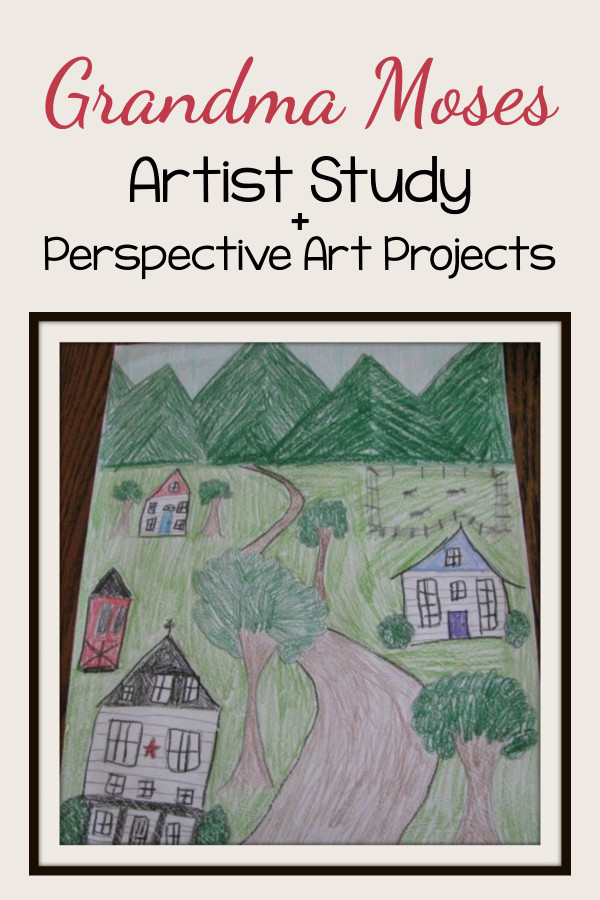
Some of you have asked how I’m handling art and artist study this year.  We are integrating artist/picture study into history.  Diana Waring has done a great job including period art and artists into her History Revealed curriculum!  On weeks when we aren’t covering historical art/artists, we’re simply doing fun projects with various media that help grow art skills – such as drawing, perspective, shading, etc.

Where do I find my art ideas?

Lots of homeschooling moms tell me they really want to include art, but don’t know where to start.  I often struggle with knowing where to go with art, too.  Some years I’ve had a serious plan in place and have spent quite some time creating themed studies.  Other years, I fly by the seat of my pants.  This year, the invention of Pinterest has helped me fly by the seat of my pants more effectively!  lol  I “pin” great ideas as I find them and simply grab one of the ideas each week as I’m planning lessons.

You are welcome to check out my art pins to add to your own idea bank.  (Quite a lot of my art pins are located on other boards.  For example, I have several GREAT art lessons pinned to my Snow and Ice board for winter lessons.  So, in other words, you might browse around my boards a bit.)

You are also welcome to enjoy my artist and picture study themes.  There are a bunch of them!

Fun with Leaves

Posted by Cindy on November 21, 2011

I {heart} Pinterest!  Seriously.  It may very well be the greatest invention on the planet.  Okay, the greatest recent invention.

Through Pinterest, I found (and archived) some fun leafy art lessons to go along with our botany studies this autumn.

While we didn’t get to all the wonderful ideas – this autumn – we found time for two of them.  The first was a lesson about layering oil pastels from Art Projects for Kids.

And the second was a fun shaving cream transfer painting from Little Wonder’s Days.

Speaking of botany, the last couple of weeks have been full of wonderful botany related field trips.

At Hallway Feeds, we were able to view the creation of specialized animal feed from start to finish.  What an amazing and utterly detailed process.  The kids were even allowed to EAT some of the feed!

At Color Point Nursery, we walked through state-of-the-art greenhouses and learned the process of growing and shipping plants on a very large scale.  At the time, there were 600,000 poinsettias set to ship out soon.  This place was huge!

I’ve lived in Kentucky my entire life and have never been to Churchill Downs.  My father-in-law owns a thoroughbred racehorse that happened to be racing at Churchill Downs last week.  Even though “our” horse came in 6th, we had a great time taking in all the sites and sounds – which can certainly count toward biology hours, right?

Enjoy your Thanksgiving week!