
33 Excellent Problem-Solving Picture Books for Better Math Thinking
Some children can calculate just fine until a math problem asks them to figure out what to do. That’s where problem-solving picture books can be especially helpful. Through engaging stories, children can watch characters work through challenges, try different approaches, notice patterns, make mistakes, and eventually find solutions.
These books give children opportunities to recognize problem-solving strategies they can use when they encounter challenging math problems of their own.
Problem-solving is closely related to logical thinking, too. If you’re looking for more ideas specifically for building logical thinking skills, you can find those here.
Mathematical Problem-Solving
Problem-solving is about more than knowing how to add, subtract, multiply, or divide. A child might know how to perform all four operations and still have trouble deciding which operation to use or how to approach an unfamiliar problem.
Sometimes, the task is straightforward, such as solving an equation. Other times, children have word problems or mathematical challenges that require them to think through the information and decide how to proceed.
For example:
“A farmer has pigs and chickens. In total, he owns 20 animals. If there are 54 legs, how many of each animal live on the farm?”
The answer is 7 pigs and 13 chickens, but a child who hasn’t learned algebra yet can still solve the problem! Drawing a picture, making a table, or using guess and check can all lead to the correct answer.
That’s an important part of mathematical problem-solving. Children learn that they don’t always have to know a formula immediately. They can use what they do know to work toward a solution.
A Simple Problem-Solving Process
A simple problem-solving process looks like this:
- Examine the problem and identify the important information.
- Choose a strategy that makes sense.
- Work through the math.
- Check the answer to see if it works.
This post contains affiliate links.
Math Problem-Solving Strategies
There isn’t one perfect strategy for every problem. In fact, one of the most valuable skills children can develop is learning to choose among several possible approaches.
10 Strategies for Solving Math Problems
- Make a list. Organize possible answers or important information.
- Draw a picture. Sketch the situation to make relationships easier to see.
- Act it out. Physically model what is happening in the problem.
- Make a model. Use blocks, counters, coins, or other objects to represent the problem.
- Make a table. Organize information so patterns and possibilities become clearer.
- Identify a pattern. Look for something that repeats or changes predictably.
- Write a number sequence. List numbers in order to reveal relationships or patterns.
- Solve a simpler, related problem. Start with an easier version and use what you learn to tackle the harder one.
- Work backward. Begin with the known result and retrace the steps.
- Guess and check. Try a reasonable solution, test it, and adjust as necessary.
Children become better problem-solvers when they have opportunities to use these strategies in meaningful situations. That’s one reason picture books work so well.
Picture books are a great way to illustrate problem-solving!
Problem-Solving Picture Books
The best problem-solving picture books don’t simply explain a math concept. They give children a reason to think about the problem and consider how a solution might be found.
Some of the books below focus directly on mathematical ideas, while others are especially useful for practicing the flexible, logical thinking that strong problem-solvers need.
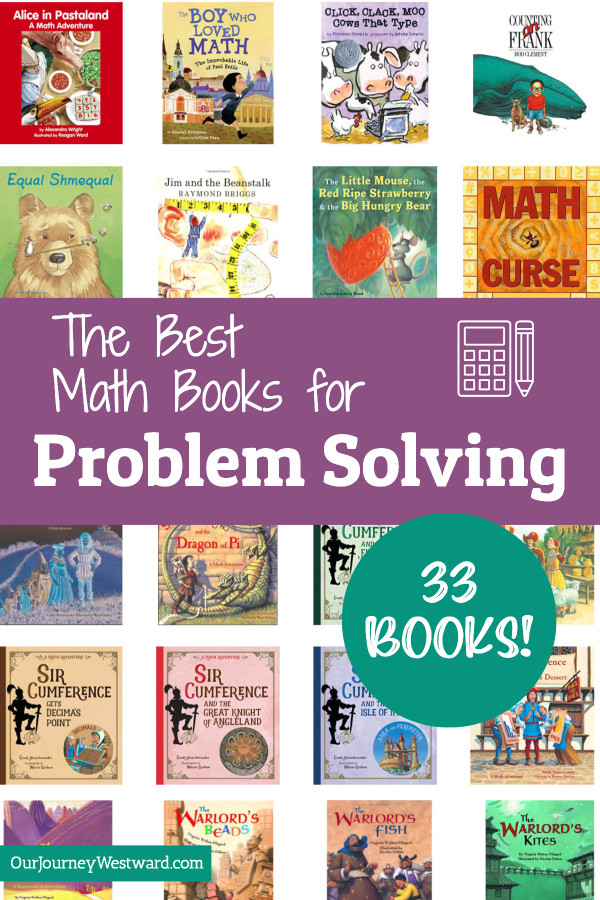
- Alice in Pastaland by Alexandra Wright – Alice runs into mathematical puzzles involving time as she travels through the past.
- The Boy Who Loved Math by Deborah Heiligman – The true story of mathematician Paul Erdős introduces children to a life filled with numbers, patterns, and mathematical thinking.
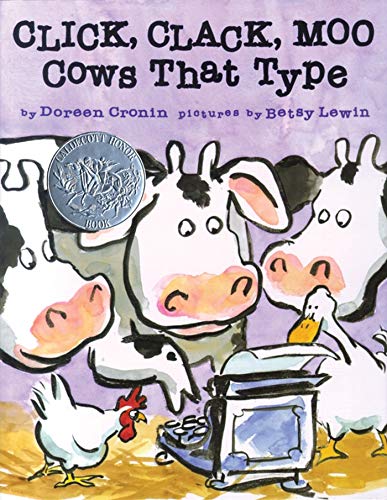
- Click, Clack, Moo Cows That Type by Doreen Cronin – A funny example of negotiation, cause and effect, and finding solutions when two sides want different things.
- Counting on Frank by Rod Clement – An imaginative boy uses estimation and mathematical thinking to answer wonderfully unusual questions about everyday life.
- Equal Shmequal by Virginia Kroll – Animals trying to create equal teams discover that “equal” can involve more thinking than simply counting.
- Jim and the Beanstalk by Raymond Briggs – Jim uses measurement to help a giant solve several very practical problems.
More Picture Books That Encourage Problem-Solving
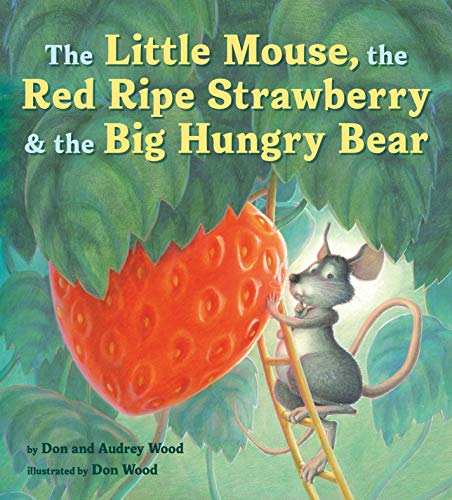
- The Little Mouse, the Red Ripe Strawberry, and the Big Hungry Bear by Audrey Wood – A simple story that invites children to consider possible solutions as Mouse tries to protect his strawberry.
- Math Curse by Jon Scieszka – Almost everything becomes a math problem in this hilarious book that encourages children to recognize mathematics in everyday situations.
- Once Upon a Dime by Nancy Kelly Allen – A money-growing tree provides a playful way to think about coins, values, patterns, and mathematical relationships.
- The Paper Bag Princess by Robert Munsch – Not a traditional math book, but a wonderful example of creative problem-solving when the obvious solutions aren’t available.
- The Poky Little Puppy by Janette Sebring Lowrey – A familiar story that can be used to notice sequences, consequences, and how repeated choices affect outcomes.
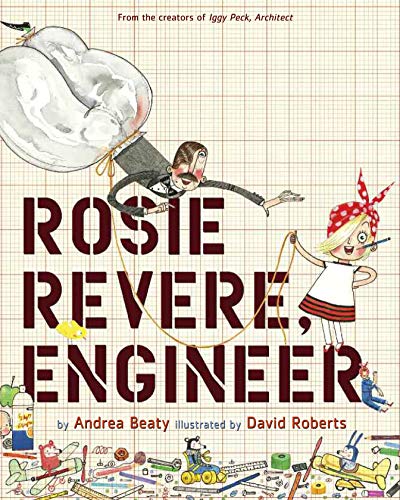
- Rosie Revere, Engineer by Andrea Beaty – Rosie demonstrates an important problem-solving habit: testing an idea, learning from failure, and trying again.
- Sold! by Nathan Zimelman – A mathematical adventure involving money, buying and selling, and the problem-solving needed to make good decisions.
- Spaghetti and Meatballs For All! by Marilyn Burns – A particularly fun way to explore area and perimeter as tables are repeatedly rearranged to accommodate dinner guests.
- The Sundae Scoop by Stuart Murphy – Children can explore combinations and systematic thinking as characters determine the possible ways to build ice cream sundaes.








The Sir Cumference Series for Problem-Solving
The entire Sir Cumference series by Cindy Neuschwander includes some of my favorite problem-solving picture books for demonstrating how mathematical thinking can help solve problems.
Rather than presenting concepts as isolated equations, the books weave mathematics into medieval adventures where characters must reason their way toward solutions. Across the series, children experience concepts such as geometry, fractions, decimals, place value, measurement, and graphing.
- Sir Cumference and All the King’s Tens
- Sir Cumference and the Dragon of Pi
- Sir Cumference and the First Round Table
- Sir Cumference and the Fraction Faire
- Sir Cumference Gets Decima’s Point
- Sir Cumference and the Great Knight of Angleland
- Sir Cumference and the Isle of Immeter
- Sir Cumference and the Off-the-Charts Dessert
- Sir Cumference and the Roundabout Battle
- Sir Cumference and the Sword in the Cone
- Sir Cumference and the Viking’s Map
You don’t need to read the series in order. Choose a book that fits a mathematical concept you’re already studying or simply pick an adventure that sounds interesting.


The Warlord’s Series for Problem Solving
Virginia Pilegard’s Warlord’s series is another favorite for mathematical problem-solving. Set in ancient China, the stories present practical challenges that require characters to observe carefully, think creatively, and use mathematical ideas to reach solutions.
The historical settings make the problems especially interesting because children see mathematical thinking used for real purposes rather than as a page of equations to complete.
- The Warlord’s Alarm
- The Warlord’s Beads
- The Warlord’s Fish
- The Warlord’s Kites
- The Warlord’s Messengers
- The Warlord’s Puppeteers
- The Warlord’s Puzzle


Helping Children Think Like Problem-Solvers
You don’t have to turn a picture book into a formal math lesson for it to build problem-solving skills. Simply pause occasionally to talk about what is happening.
Ask questions like:
- What is the problem?
- What information do we already know?
- What could the character try?
- Why didn’t that solution work?
- Do you notice a pattern?
- Is there another way to solve the problem?
- Does the final answer make sense?
Over time, children begin to recognize that challenging problems aren’t necessarily solved by immediately knowing the answer. Good problem-solvers observe, experiment, organize information, try strategies, make adjustments, and keep thinking.
Problem-solving picture books make these thinking habits visible and memorable. Paired with opportunities to practice strategies like drawing pictures, making tables, looking for patterns, and working backward, they can help children become more confident mathematical thinkers.
Other posts you may like
Our Journey Westward products you may like
-

-
Math in Nature$20.00
-
Loving Living Math$15.00



Make Science Meaningful and Fun
Experience a free No Sweat Nature Study class to see how easy and engaging science can be.
Kid-friendly science through the lens of nature study
Creative nature journaling with every lesson
Flexible and fun for the whole family