
Watermelon Nature Study: Why do some fruits have thick rinds?
Why does a watermelon have a thick rind while a grape has only a thin skin? In this watermelon nature study podcast episode, kids will discover why fruits have different kinds of coverings and how those coverings help them survive as they grow.
We’ll explore how watermelons protect their watery interiors, how orange peels help protect the juicy fruit inside, and how coconuts are equipped for long ocean voyages. Families will also learn why some fruits need thick rinds while others can get by with only a thin skin, leading to fascinating discussions about seed protection, water conservation, seed dispersal, and the relationship between form and function in nature.
Watermelon Nature Study
Use these questions to spark a discussion after listening to the podcast, check for understanding, or inspire a little extra research. Younger children may enjoy answering the questions orally, while older students can write their answers in a nature journal or science notebook.
- What is one of the main jobs of a fruit? (To protect and help distribute the seeds inside.)
- Why does a watermelon need a thick rind? (To protect the fruit and help keep water inside while it grows.)
- About what percentage of a watermelon is water? (More than 90 percent.)
- What can you sometimes see when you peel an orange? (Tiny sprays of oil coming from the peel.)
- How do orange peels help the fruit? (They help protect the juicy fruit inside and keep it from drying out.)
- Why does a coconut have such thick protective layers? (They help protect the seed and allow the coconut to travel by water.)
- Why doesn’t every fruit have a thick rind? (Different fruits face different challenges and don’t all need the same amount of protection.)
- What do the rind of a watermelon, the peel of an orange, and the shell of a coconut have in common? (They all help protect the fruit and the seeds inside.)
Watermelon Nature Study Video Class
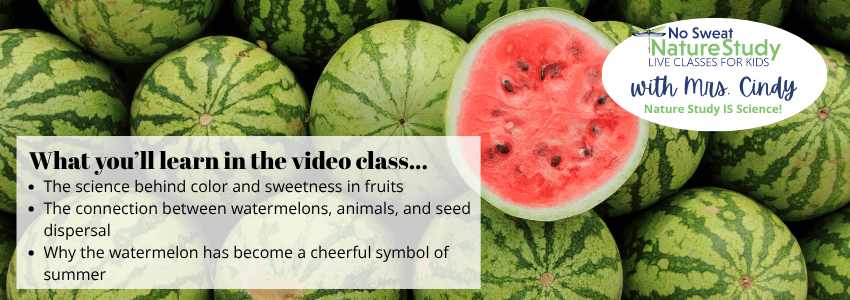
Watermelons are much more interesting than most people realize. In the watermelon video class with Mrs. Cindy, students investigate watermelon anatomy, learn why watermelons are classified as berries, and discover how their seeds are dispersed. Also, learn the characteristics that make watermelons members of the cucurbit family.
During the class, students create a nature journal page that helps them record observations and important facts. The lesson combines science, nature study, and journaling while encouraging students to look more closely at a fruit they may have eaten dozens of times without really examining.
The watermelon video lesson is one of more than 200 lessons available in No Sweat Nature Study. The library includes topics from life science, earth science, weather science, space science, and physical science, all taught through engaging nature-based lessons.
Would you like to record a voicemail to answer this season’s nature study question?
At the end of each No Sweat Nature Study Podcast episode, Mrs. Cindy includes messages from a few of her friends. You can record a message that she might use on an upcoming episode!
Please visit the podcast page. Scroll to the bottom to find this season’s question and the voice recorder.
Please leave a rating or a review on your podcast app! It helps the podcast to show up for more people…which means more families can enjoy science through the wonderful lens of nature study! Thank you!
Make Science Meaningful and Fun
Experience a free No Sweat Nature Study class to see how easy and engaging science can be.
Kid-friendly science through the lens of nature study
Creative nature journaling with every lesson
Flexible and fun for the whole family