
A Delicious Vanilla Nature Study for Kids
Open a bottle of vanilla extract, and the smell reaches you before you lean in. Nothing touches your nose, yet you know right away what it is. This vanilla nature study starts with that everyday moment and asks what is actually traveling through the air, and why so many people enjoy it.
Listen to the No Sweat Nature Study Podcast with your family while the cookies bake. Mrs. Cindy follows vanilla’s smell from the bottle to the receptors high inside the nose, explains why smells and memories are so closely linked, and shares what scientists learned when they asked people around the world to rank their favorite smells.
Vanilla Nature Study
Pass these questions around the table after you listen. Let younger listeners try the first few, and save the trickier ones for older kids.
- What are the tiny particles that drift from a bottle of vanilla extract into the air called?
(They are called molecules.) - About how many different kinds of smell receptors do scientists think people have?
(Scientists think people have around 400 different kinds.) - What is olfaction?
(Olfaction is the sense of smell.) - What is the name of the molecule that gives vanilla most of its smell?
(It is called vanillin.) - Why can a smell bring back a memory so quickly?
(The part of the brain that first sorts out smells is closely connected to the parts that handle emotions and memories.) - What happens to the flavor of a jelly bean when you pinch your nose closed?
(It tastes sweet but not much else, and the full flavor returns when you let go because much of flavor comes from smell.) - When researchers asked people in very different places to rank ten smells, which one came out on top?
(Vanillin, the vanilla smell, was ranked the most pleasant.) - Does everyone love the smell of vanilla?
(No. Personal preference mattered a great deal, so some people like other smells better.)
Vanilla Video Class
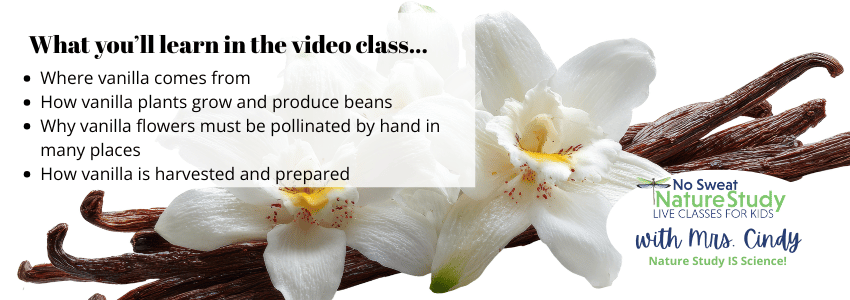
Before vanilla reaches a bottle, it grows on a climbing orchid vine in a warm, tropical place. The Vanilla video class looks at how that vine grows, why each flower in most vanilla farms must be pollinated by hand, and how the pods are harvested and cured until their smell develops.
In the nature journal, students sketch the vanilla vine and label its parts, then draw flowers and pods at different stages. A simple diagram of hand pollination shows how a flower becomes a bean, and notes on how vanilla is grown and used around the world round out the page. Mrs. Cindy does the teaching, so the whole family can learn together. The class is included in No Sweat Nature Study membership. Use code NOSWEAT for $10 off the first quarterly subscription payment.
Send Mrs. Cindy a Voice Message!
I’d love to hear from your family! Visit the No Sweat Nature Study Podcast page to find the current listener question, then record your answer at the bottom of the page. Parents can join in, too. Your recording could be chosen for an upcoming episode.
Please leave a rating or a review on your podcast app! It helps the podcast reach more people…which means more families can enjoy science through the wonderful lens of nature study! Thank you!
Make Science Meaningful and Fun
Experience a free No Sweat Nature Study class to see how easy and engaging science can be.
Kid-friendly science through the lens of nature study
Creative nature journaling with every lesson
Flexible and fun for the whole family