
Two Free Candy Heart Valentine’s Day Math Printables
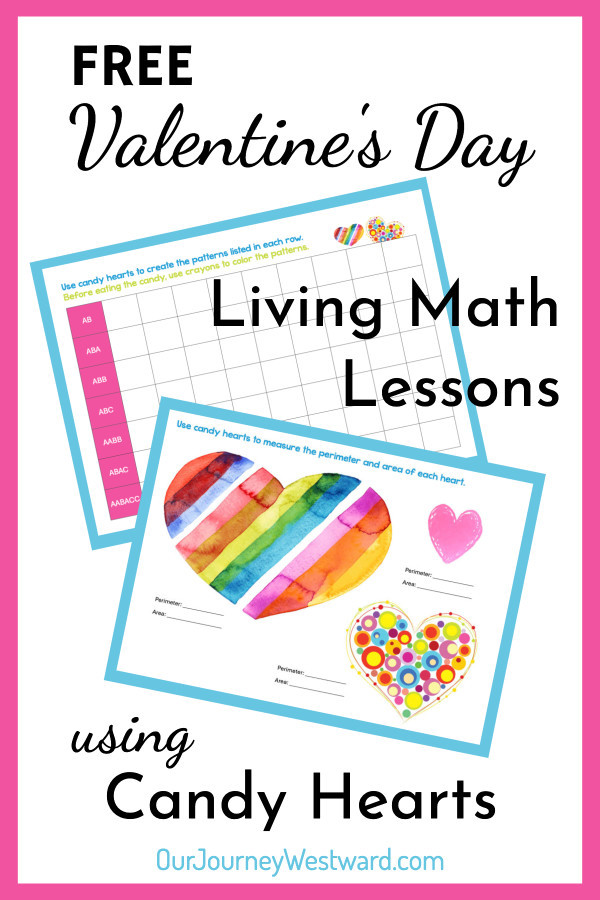
Are math lessons monotonous this winter? These FREE Valentine’s Day math printables should help to inspire some fun learning! Candy motivates kids, and these lessons use candy hearts to bring sweet smiles to elementary students.
Candy Heart Valentine’s Day Math Lessons
Hands-on math connects concepts in a child’s brain. By building patterns and practicing measurement (the activities suggested today), children gain a kinesthetic and visual understanding of the topics. In doing so, the brain builds a knowledge base that can be used repeatedly to understand concepts as they become more complex.
Connecting hands-on math to a special holiday adds an extra layer of excitement for children. Of course, more excitement for any lesson means the learning is very likely to stick. Both in knowledge and memory, for even more powerful recall.
These two Valentine’s Day math activities are quite simple. There is nothing ground-breaking or difficult in the activities or the concepts. However, the simplest of activities can be powerful for learning new concepts or practicing old ones.
Free Valentine’s Day Math Printables
Download two free printables! One helps children learn about patterns and the other helps to explore perimeter and area. Both activities encourage the use of conversation hearts, which can be purchased inexpensively at a dollar store. Feel free to use small heart stickers if a sugar rush isn’t in the daily plans.
The directions for each activity are fairly self-explanatory, but more detailed directions are provided below. Each child will need a copy of the pattern worksheet, a large handful of conversation hearts (or stickers), and crayons in the colors of the hearts.
What are patterns in elementary mathematics?
Patterns are repeated arrangements of colors, shapes, numbers, and other elements. Patterns can be given names to represent the entire segment of the pattern arrangement. A color pattern that is red, blue, yellow, red, blue, yellow, red, blue, and yellow includes a base segment. The base segment is red, blue, and yellow. That segment is the thing that is repeated indefinitely.
Using Pattern Rules with Children
To name a segment, letters are often used as a representation of each part of the segment. The red, blue, and yellow pattern example is called an ABC pattern. That means there are three parts to the segment: A = red, B = blue, and C = yellow.
The ABC pattern is called a rule. Endless pattern rules can be created. Here are just a few examples: AB, AAB, AABC, ABCCD, and ABBCDEE. Let’s look at ABCCD. When given this rule, a color must be assigned to each letter. For instance, A = pink, B = purple, C = yellow, and D = orange. Picture the color assignments as a map’s key.
Now it’s time to follow the rule and build the pattern. If the pattern rule is ABCCD, the letter assignments dictate the base segment: pink (A), purple (B), yellow (C), yellow (C), and orange (D). That segment continues to repeat indefinitely: pink, purple, yellow, yellow, orange, pink, purple, yellow, yellow, orange, pink, purple, yellow, yellow, orange, pink, purple, yellow, yellow, orange…
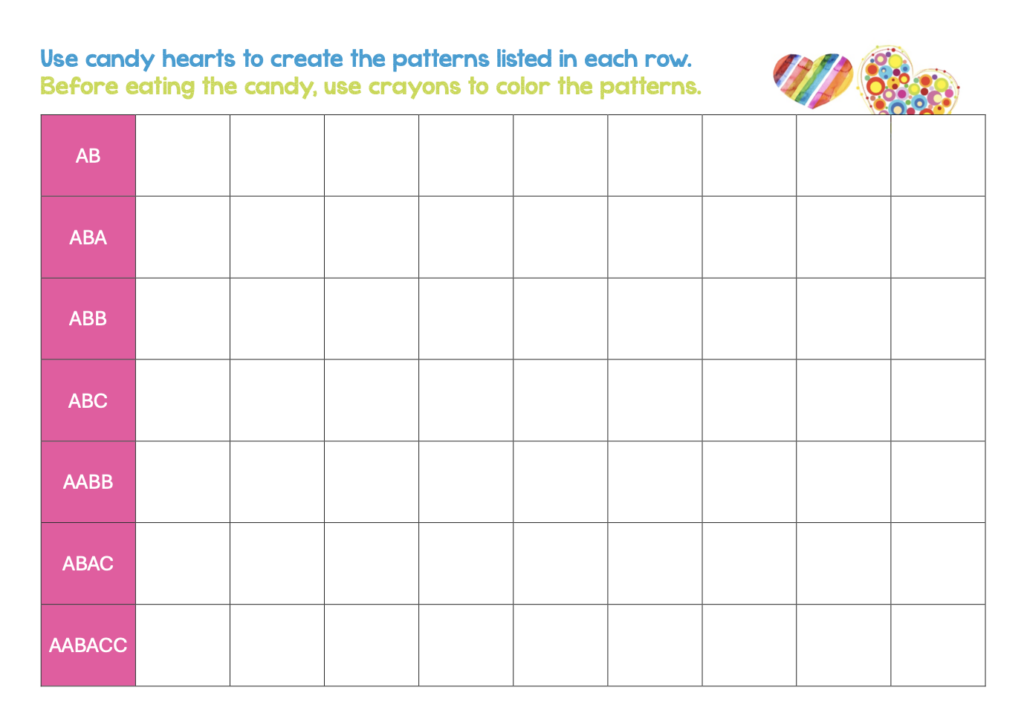
Practice Patterning with Candy Hearts
Children can use the pattern printable to assign colors and follow pattern rules using candy hearts.
What are perimeter and area in elementary mathematics?
Perimeter is the measurement of the boundary line around a closed geometric figure. In other words, it’s a measure of the total length around the outside of a shape.
Area is the measurement of the total area of a 2-D shape. In other words, it’s a measure of the space that is taken up by the flat surface of a shape (or object).
Perimeter and area can be measured using standard measuring tools like rulers. However, non-standard measuring tools can be used as well. Candy hearts are used as a non-standard measurement tool in the free printable.
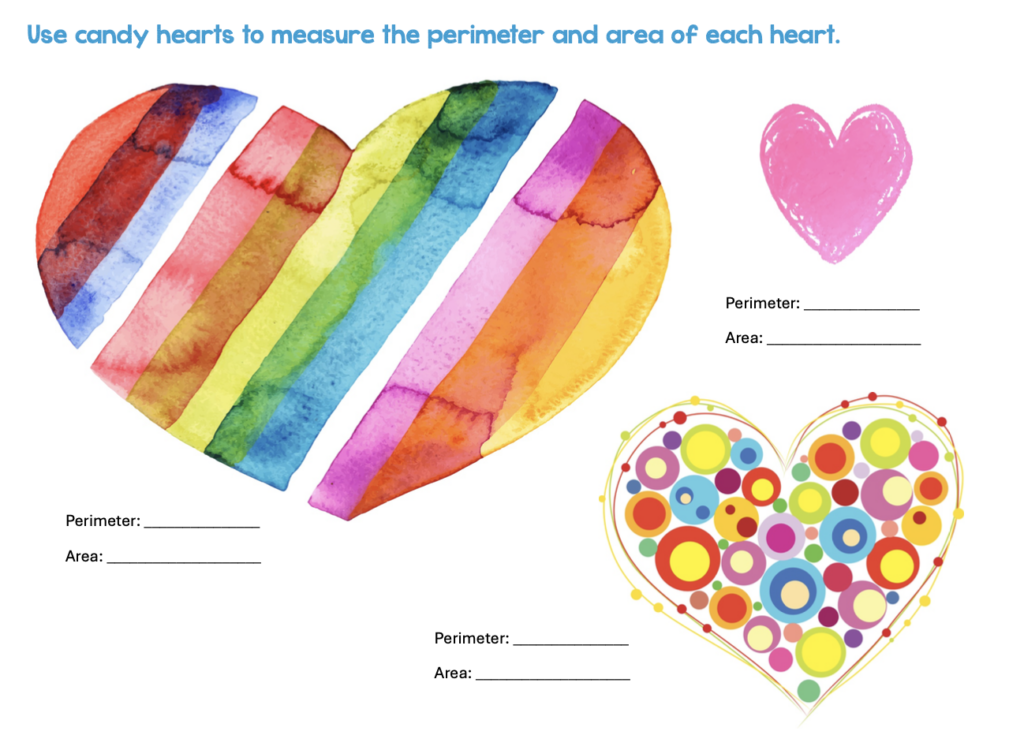
Practice Measurement with Candy Hearts
Using the measurement printable, place candy hearts around the edge of each heart on the paper. Count how many candy hearts it takes to go all the way around the hearts and write each number on the appropriate line.
To measure the area, place as many candy hearts as will fit on the surface of each heart. Try not to go outside the boundary lines. Count the hearts inside the paper hearts and write each number on the appropriate line.
More Educational Valentine’s Day Ideas
Enjoy MANY more educational ideas for Valentine’s Day math using candy hearts. Easily fill an entire day or two with fun and serious learning. It’s a great way to push away the winter doldrums!
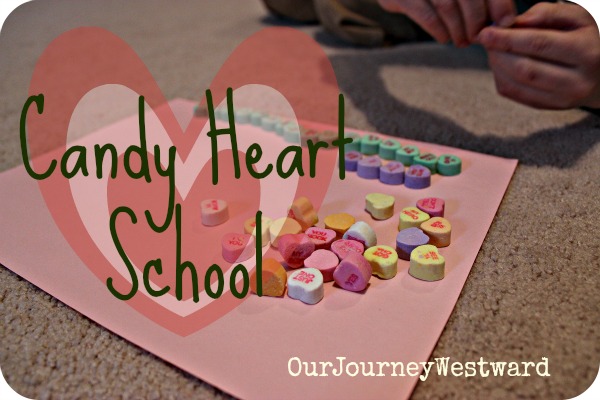
Learn How to Do More Living Math Lessons
The how-to book Loving Living Math is a quick, easy read with TONS of practical ideas for incorporating more of these into your homeschool.
Other Resources You May Like
-

-
-
Math in Nature$20.00


These are fun, Cindy! I’d love for you to link-up with my Printable Power meme, but you don’t have to. 🙂
https://www.walkingbytheway.com/blog/?p=715675
I am looking for a better resource for teaching the area and perimeter topic in Maths and I think I have found it here. Thanks a lot, Cindy.
Great, Adelien! 🙂