
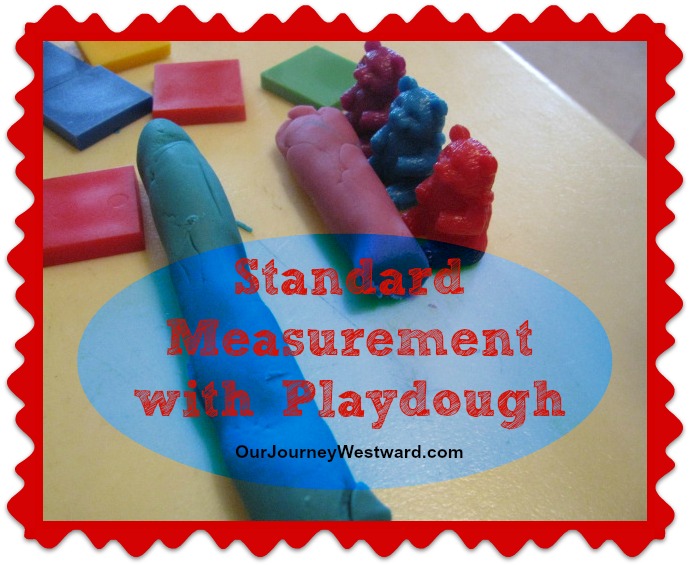
How to Teach Standard Measurement with Play Dough
This hands-on, literature-based math activity will help your younger students gain a concrete understanding of the concept of standard measurement.
Target Age Range: K-2
Skills Covered: non-standard measurement, standard measurement, making comparisons, fine motor skills, reading
Understanding measurement doesn’t have to be hard for little ones. In fact, teaching it early with concrete materials builds an in-depth understanding that will last a lifetime!
This post contains affiliate links.
When teaching measurement to young children, always begin measuring things with “non-standard” tools. That means you will supply crackers, paper clips, M&M’s, counting bears, or whatever else floats your fancy for measuring things. Give your child LOTS of experience measuring with non-standard measuring tools.
Comparing Measurements with Non-Standard Measuring Tools
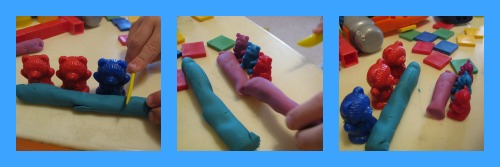
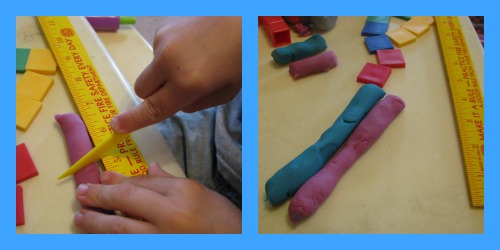
In the activity pictured above, I wanted to help my kindergartener understand that not all measurements are equal. When mom says she needs a length of playdough that is 3 bears long, does she mean a length of 3 BIG bears or 3 SMALL bears? Is there a difference??
I asked Eli to roll out two snakes with playdough. He placed 3 big bears next to one of the snakes and cut the playdough to show the length. He placed 3 small bears next to the other snake and again cut the playdough to show the length. It was very clear to him that there was a difference between the two measurements. I asked probing questions for him to consider. “Why is one snake bigger than the other?” “Do you think the same thing would happen if I measure something with my big feet and you measure it with your little feet?”
Comparing Non-Standard Measurements with a Literature Connection
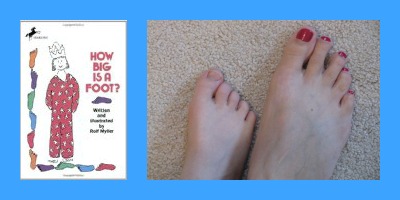
We decided to see how far I could walk, taking five steps (toe to heel) vs. how far he could walk, taking five steps. We measured things like tables and bookshelves in my feet vs. his feet. Then we sat down to read one of my favorite math books ever, How Big Is a Foot?
In this book, the author helps a child understand the need for “standard” measurements – like inches, feet, and yards. It’s a great book to use when your child is ready to transition from non-standard to standard tools for measuring!
Concrete Practice with Standard Measuring Tools
After reading the book, but before jumping right into measuring in abstract terms like inches and feet, I wanted Eli to have a solid understanding that standard measurements are always the same.
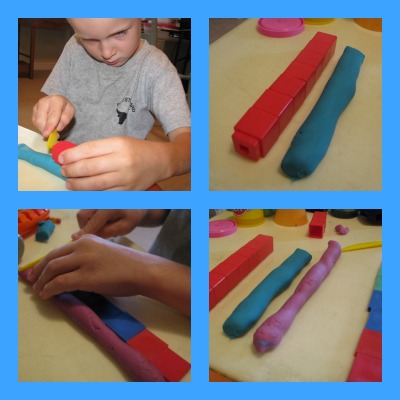
I pulled out our unifix cubes, and we compared them to see that each one was exactly the same size. I asked, “If mom makes a playdough snake 7 cubes long and you make a playdough snake 7 cubes long, do you think our snakes will be the same size?” “Why?” “Let’s try!”
We made several snakes this way to help him understand that our snakes should always be the same, as long as we use the same-sized measuring tool.
Introducing “Real” Measurements
I pulled out two rulers and asked Eli to explore them. He noticed numbers and lines, and that the numbers on one ruler are in the same place as on the other ruler. We talked about how rulers are the standard measurement for everybody. I could have a ruler at Grandma and Grandpa’s house, cut an 8-inch playdough snake, bring it home, and it would be the same length as the snake he cut while I was away, using his own ruler.
We practiced making snakes using different rulers and (surprise) they always came out the same length!
Enjoy teaching your little one about measurement in a fun, real, and super-meaningful way!
Great Measurement Picture Books for Kids
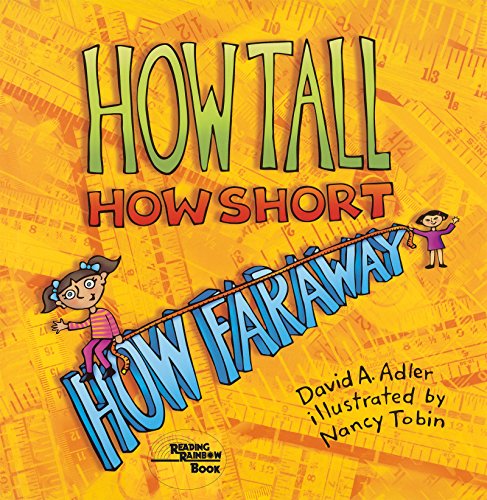
Picture books are a wonderful way to make measurement feel meaningful. Through stories, children can see measurement used in everyday situations while naturally building vocabulary and understanding. These early elementary living books help bring concepts like length, height, weight, and comparison to life, making measurement much more memorable than a worksheet ever could.




Helpful Living Math Resources
Activities like this playdough measurement lesson are just one example of how math can be active, memorable, and enjoyable. If you’d like even more ideas for teaching math through living books and real-life experiences, take a look at my Loving Living Math video training and how-to guide.
-

-
Product on saleLoving Living MathOriginal price was: $15.00.$10.00Current price is: $10.00.



Make Science Meaningful and Fun
Experience a free No Sweat Nature Study class to see how easy and engaging science can be.
Kid-friendly science through the lens of nature study
Creative nature journaling with every lesson
Flexible and fun for the whole family
It is very creative way to teach the young about measurement. Elly must be very busy at that time.