
What Makes an Animal Good at Moving? An Animal Movement Nature Study
How does a squirrel race headfirst down a tree without tumbling to the ground? Its ankle joints can rotate until its back feet point backward, giving its claws a better grip on the bark. That surprising detail is just one of the animal movements featured in this Jim Arnosky nature study podcast episode!
Cheetahs lengthen their strides with flexible spines, while dolphins slice through water with streamlined bodies. Kangaroos even reuse energy from one hop to help power the next. Listen together to find out how body features help animals run, climb, swim, fly, and hop.
Drawing Motion with Jim Arnosky Nature Study
Turn the science from this episode into a quick family challenge! Take turns answering the questions, and go back to the podcast together when a detail stumps everyone.
- Which parts of an animal’s body work together to create movement?
(The brain, nerves, muscles, bones, and joints work together to create movement.) - How does a cheetah’s flexible spine help it run quickly?
(The spine bends and stretches so the cheetah’s legs can extend farther apart and cover more ground with each stride.) - How does a cheetah’s long tail help during a chase?
(A cheetah’s long tail helps it balance and control its body through quick turns.) - What unusual movement can a squirrel make with its ankle joints?
(A squirrel can rotate its ankle joints so its hind feet point backward as it climbs down a tree.) - What is drag?
(Drag is the force that pushes against an animal as it moves through water.) - How do dolphins move their tails when swimming, and how do most fish move theirs?
(A dolphin moves its tail flukes up and down, while most fish bend their bodies and move their tails from side to side.) - What tradeoff comes with the long, narrow wings of an albatross?
(Long, narrow wings allow an albatross to glide efficiently over the ocean, but they make quick turns among crowded branches more difficult.) - How do a kangaroo’s tendons make repeated hopping more efficient?
(The tendons stretch to store some energy when the kangaroo lands and then return that energy to help power the next hop.)
Drawing Motion with Jim Arnosky Nature Study Video Class
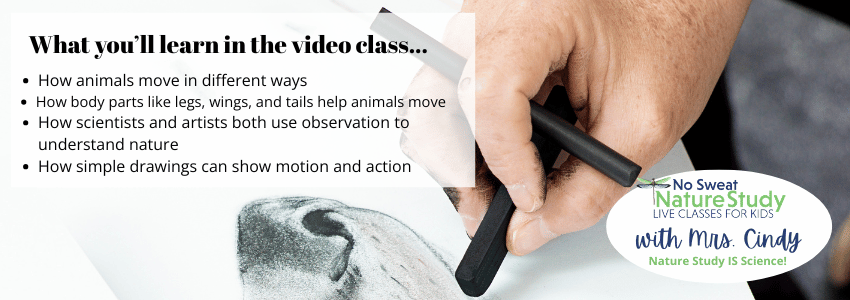
The Drawing Motion No Sweat Nature Study video class connects scientific observation with the art of capturing animals in action. Inspired by Jim Arnosky’s book Drawing Life in Motion, the class examines how body position, line, and shape can communicate speed, direction, balance, and motion.
Families will study animals as they run, fly, swim, and climb, then experiment with techniques for creating action rather than stiff poses. Mrs. Cindy guides the science and nature journaling step by step. Use code NOSWEAT for $10 off the first quarterly subscription payment.
Please leave a rating or a review on your podcast app! It helps the podcast to show up for more people…which means more families can enjoy science through the wonderful lens of nature study! Thank you!
I Want to Hear From You!
Head over to the No Sweat Nature Study Podcast page to answer the current call-in question. (Scroll to the bottom of the page.) Your recording might be one of the answers we hear together in an upcoming episode!
Make Science Meaningful and Fun
Experience a free No Sweat Nature Study class to see how easy and engaging science can be.
Kid-friendly science through the lens of nature study
Creative nature journaling with every lesson
Flexible and fun for the whole family