
Can Sound Travel Through Water? Amazing Facts to Hear
Sound travels about four times faster through water than through air. So why does a sharp slap against a swimming pool wall sound like a muffled thump beneath the surface? This underwater sound nature study investigates that puzzling difference between how water carries sound and how our ears receive it.
Listen to the No Sweat Nature Study Podcast with your family, starting with a humming experiment that makes sound vibrations easy to feel. Follow those vibrations through air and water, then hear how whales use calls to stay in contact and dolphins use returning echoes to locate fish.
Underwater Sound Nature Study
Let everyone take a turn asking a question and see which answers get the whole family talking. Nobody remembers one? Replay that part of the podcast and listen for the clue together!
- What does it mean when something vibrates?
(Something vibrates when it moves back and forth.) - How do tiny particles carry sound through air or water?
(The particles move back and forth, pushing against neighboring particles and passing the vibrations along.) - Does sound travel only through air and water?
(Sound can also travel through solids, such as the wall of a swimming pool.) - How does the speed of sound in water compare with its speed in air?
(Sound travels through water about four times faster than it travels through air.) - Why can a sharp slap against a pool wall sound muffled to someone underwater?
(Water touching the outside of the eardrum makes it harder for the eardrum to vibrate freely, changing how sound passes through the ear.) - How do whale calls help whales that are too far apart to see each other?
(Whale calls can travel for miles through water, helping distant whales stay in contact.) - Does a fish have to make a sound for a dolphin to locate it using echolocation?
(The fish does not have to make a sound because the dolphin listens for echoes of its own clicks reflected from the fish.) - How can a dolphin use an echo to tell how far away a fish is?
(The time between the dolphin’s click and the returning echo helps it tell how far away the fish is.)
Echoes in Nature Video Class
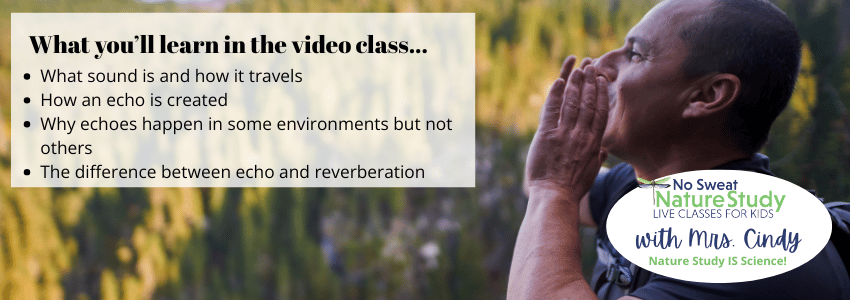
A canyon can send a shout right back, while a forest seems to swallow it. What makes the difference? The Echoes in Nature video class takes sound beyond the swimming pool to investigate how rock walls, tree trunks, and other natural surfaces affect what can be heard.
The nature journal becomes a place to trace an echo’s round trip with drawings that make the science easier to picture. A drawing of the human ear follows the sound a little farther, showing how a returning echo becomes something familiar: a voice calling back!
Enjoy this class through No Sweat Nature Study membership. Use code NOSWEAT for $10 off the first quarterly subscription payment.
Be Part of the Podcast!
I’d love to hear from your family! Visit the podcast page to find the current listener question and record an answer for me. Your voice message might be featured in an upcoming No Sweat Nature Study Podcast episode!
Please leave a rating or a review on your podcast app! It helps the podcast to show up for more people…which means more families can enjoy science through the wonderful lens of nature study! Thank you!
Make Science Meaningful and Fun
Experience a free No Sweat Nature Study class to see how easy and engaging science can be.
Kid-friendly science through the lens of nature study
Creative nature journaling with every lesson
Flexible and fun for the whole family