
Why do some ocean animals live in groups?
Why do schools of fish, pods of dolphins, and sea lion colonies spend so much time together when the ocean is so vast? In this episode of the No Sweat Nature Study Podcast, we’ll learn why living in groups gives ocean animals an advantage. It’s also the perfect companion to a coral reef nature study as you begin learning about life beneath the waves.
From avoiding predators to finding food and raising their young, ocean animals often survive better together than they do alone. Listen in to hear how schools, pods, and colonies help sea creatures thrive in the ocean.
Coral Reef Nature Study
Use these discussion questions after listening to the podcast to reinforce key concepts and check for understanding. Encourage your children to answer in complete sentences and support their responses with details they heard in the episode.
- Why do many ocean animals choose to live in groups?
(Many ocean animals live in groups because it helps them stay safer, find food more easily, and raise their young.) - What is a group of fish called?
(A group of fish is called a school.) - What is the confusion effect?
(The confusion effect is a survival strategy that makes it difficult for predators to focus on one fish in a moving group.) - How does living in a school help fish spot danger?
(Living in a school helps fish spot danger because many fish are watching for predators at the same time.) - How do dolphins sometimes work together to catch food?
(Dolphins may surround a school of fish and herd the fish into a tighter group before taking turns swimming through to eat.) - Why are sea lion colonies helpful for young pups?
(Sea lion colonies help protect young pups because they grow up surrounded by many other sea lions.) - Besides protection, what are two other advantages of living in a group?
(Living in a group can make it easier to find food and to care for and teach young animals.) - Name one ocean animal from the podcast and explain how living in a group helps it survive.
(Answers may include fish, dolphins, or sea lions, along with an explanation of how the group provides protection, helps find food, or raises young.)
Coral Reef Nature Study Video Class
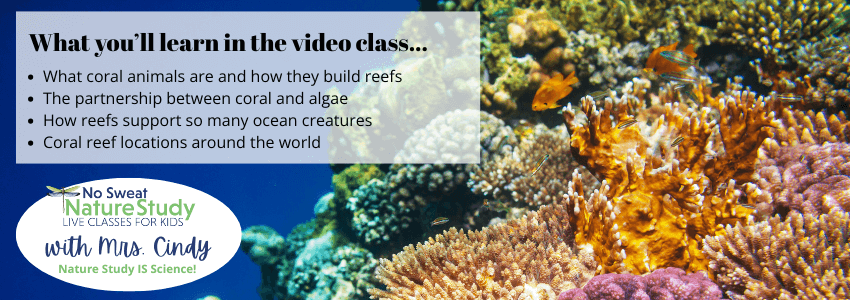
Ocean animals don’t just live in groups. Many of them depend on entire underwater communities to survive. That’s exactly what you’ll see in our upcoming Coral Reefs video class, where we’ll learn how tiny coral animals build one of the most important ecosystems on Earth and why so many sea creatures depend on it.
No Sweat Nature Study members can join the class live or watch the replay anytime in the video library. Membership also includes more than 200 recorded science lessons, twice-monthly live classes, and resources that make science one of the easiest parts of your homeschool week. If you’re ready for engaging, family-style science, I’d love to welcome you to No Sweat Nature Study.
Free Booklist of Nature Study Literature
The No Sweat Nature Study Podcast community has been sharing recommendations of excellent nature-themed books. Click here to find a compilation of listener favorites!
Would you like to record a voicemail to answer this season’s nature study question?
I’d love to hear from you! Visit the podcast page to find this episode’s call-in question and leave your voice recording. Your answer might even be featured in a future episode of the No Sweat Nature Study Podcast!
Please leave a rating or a review on your podcast app! It helps the podcast to show up for more people…which means more families can enjoy science through the wonderful lens of nature study! Thank you!
Make Science Meaningful and Fun
Experience a free No Sweat Nature Study class to see how easy and engaging science can be.
Kid-friendly science through the lens of nature study
Creative nature journaling with every lesson
Flexible and fun for the whole family