
What’s the fastest bug in the world?
Have you ever watched a dragonfly dart across a pond and wondered how anything so small can move so quickly? In this episode of the No Sweat Nature Study Podcast, we investigate insect speed by comparing some of the fastest bugs on Earth, including tiger beetles, horseflies, and dragonflies. Along the way, you’ll pick up a few fascinating facts to add to your next dragonfly nature study.
Not every speed champion uses the same strategy. Some insects excel at running, while others rely on powerful flight, quick acceleration, or sharp turns to catch prey and avoid danger. Listen in to learn which insects rank among the fastest and why agility plays such an important role in the insect world.
Podcast Comprehension Questions: Fastest Bugs
After listening to the podcast episode, use these questions to check your children’s comprehension. Encourage complete sentences when answering and discuss any questions that require a little more thought.
- What insect did Mrs. Cindy notice zipping around the ponds on her farm?
(Mrs. Cindy noticed dragonflies zipping around the ponds on her farm.) - Why is it difficult to decide which insect is the fastest in the world?
(It is difficult to decide because some insects are the fastest runners, while others are the fastest fliers or have the best acceleration and agility.) - What is one reason tiger beetles are famous among insects?
(Tiger beetles are famous for being among the fastest-running insects in the world.) - Why do tiger beetles sometimes stop while chasing prey?
(Tiger beetles sometimes stop because they can run so fast that they have trouble processing what they see.) - Why are horseflies often found around horses, cattle, and other large animals?
(Female horseflies are often found around large animals because they feed on blood.) - What scientific word describes how quickly something increases its speed?
(The scientific word that describes how quickly something increases its speed is acceleration.) - How do dragonflies use their speed and acceleration when hunting?
(Dragonflies use their speed and acceleration to catch other insects while flying and to keep up with prey that changes direction.) - What is the difference between speed and agility?
Speed is how fast something moves, while agility is the ability to move quickly while staying in control.)
Dragonfly Nature Study Video Class
Dragonflies are some of the most skilled fliers in the insect world, but speed is only one part of their story. In the Dragonfly video class, students will learn about the complete dragonfly life cycle, from egg to underwater nymph to winged adult, while discovering the adaptations that help these insects survive and hunt.
The class also includes a guided nature journal activity that helps students record what they learn through words and illustrations. It’s a great next step for families who enjoyed this podcast episode and want to take a closer look at one of the most fascinating insects around ponds, streams, and wetlands.
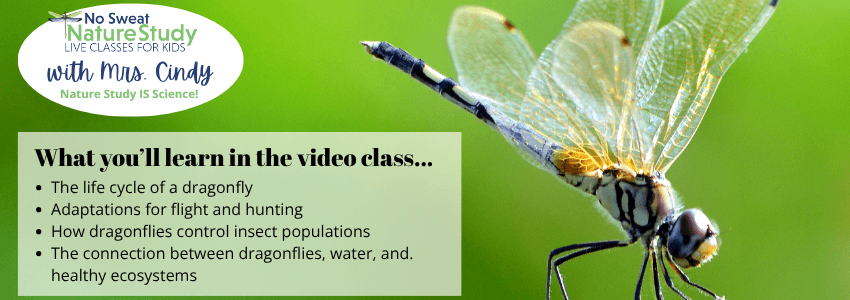
The Dragonfly video class is available inside the No Sweat Nature Study membership, where students learn science through engaging video lessons and nature journaling activities. In this class, they’ll follow the dragonfly life cycle from egg to underwater nymph to adult and discover the adaptations that help dragonflies hunt, survive, and thrive.
The Dragonfly class is just one of more than 200 science-rich classes included in the membership. Families can also study topics such as Pond Insects, Insect Life Cycles, Macroinvertebrates, Wetlands, Camouflage, and many other subjects that help students make meaningful connections between science concepts and the living things they observe outdoors.
Would you like to record a voicemail to answer this season’s nature study question?
You can find the voice recorder here. Scroll to the bottom of the page.
Please leave a rating or a review on your podcast app! It helps the podcast to show up for more people…which means more families can enjoy science through the wonderful lens of nature study! Thank you!
Make Science Meaningful and Fun
Experience a free No Sweat Nature Study class to see how easy and engaging science can be.
Kid-friendly science through the lens of nature study
Creative nature journaling with every lesson
Flexible and fun for the whole family