
Do animals wear armor? Animal Adaptations Nature Study for Kids
Why do some animals seem almost armored? In this informative podcast episode, children learn how turtles, beetles, armadillos, and hedgehogs protect themselves from danger in the wild. They’ll hear about shells, armored plates, exoskeletons, and sharp spines while learning how animal adaptations help creatures survive.
The episode also introduces scientific vocabulary, such as exoskeleton and chitin, while encouraging children to think about the many ways animals are designed for protection and survival. With fun facts, memorable comparisons, and meaningful science connections, this episode helps children better understand the amazing ways animals survive in nature.
Animal Adaptations Nature Study
Use these questions to chat with your children after listening to the episode. They’re great for reviewing science concepts and helping children remember what they learned.
- What bones are turtles connected to inside their shells?
(Their ribs and spine) - What are the two main parts of a turtle’s shell called?
(The carapace and the plastron) - What is the name of the protective outer covering on insects like beetles?
(An exoskeleton) - What material makes up an insect’s exoskeleton?
(Chitin) - What process happens when an insect sheds its old outer covering?
(Molting) - What does the word “armadillo” mean?
(Little armored one) - What are the bony plates on an armadillo called?
(Scutes) - What animal curls into a tight ball with sharp spines sticking out?
(A hedgehog)
Animal Adaptations Nature Study Video Class
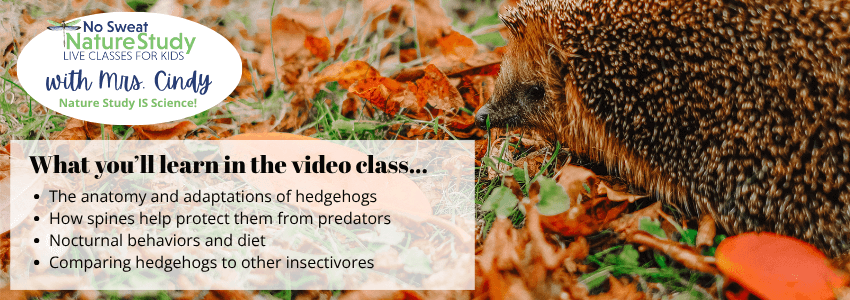
This podcast episode pairs perfectly with the No Sweat Nature Study video class about hedgehog adaptations. In class, 1st-8th graders learn more about how hedgehog spines protect them, how their snouts help them find food, and how their nocturnal habits help them survive in the wild. As they learn, they create and label a detailed diagram of hedgehog adaptations to reinforce the science in a creative, hands-on way.
No Sweat Nature Study helps children learn real science through engaging video lessons that combine detailed scientific learning with creativity and nature journaling. Families in the membership enjoy hundreds of classes on animals, plants, weather, space, and earth science, designed especially for 1st-8th graders. Ready to give it a try? Watch the free symbiosis sample class!
Leave Mrs. Cindy a Voicemail
You can leave a recording to answer this season’s question by scrolling to the bottom of the No Sweat Nature Study Podcast page here.
Please leave a rating or a review on your podcast app! It helps the podcast to show up for more people…which means more families can enjoy science through the wonderful lens of nature study! Thank you!
Make Science Meaningful and Fun
Experience a free No Sweat Nature Study class to see how easy and engaging science can be.
Kid-friendly science through the lens of nature study
Creative nature journaling with every lesson
Flexible and fun for the whole family