
What are some of the coolest things you can see in the night sky?
The night sky is full of incredible sights for curious nature explorers. In this episode of the No Sweat Nature Study Podcast, children learn about three amazing things you might see after dark: shooting stars, comets, and the Northern Lights. A northern lights nature study is a wonderful way to spark curiosity about the sky while helping kids understand what they are actually seeing when they look up at night.
During the episode, listeners learn what causes meteors to streak across the sky, why comets grow glowing tails when they move closer to the Sun, and what the Northern Lights look like when they appear in the night sky. These simple explanations help kids connect observation with science and encourage families to spend time looking up and noticing what is happening above them after dark.
Northern Lights Nature Study
Use these questions to check comprehension after listening to the episode. They’re perfect for reviewing the topics and starting great discussions.
- What is the streak of light called when a meteoroid burns up in Earth’s atmosphere? (A meteor)
- What are comets sometimes called because of what they are made of? (Dirty snowballs)
- What happens to some of the frozen ice on a comet when it moves closer to the Sun? (It changes directly into gas.)
- What forms around a comet when gas and dust drift away from it near the Sun? (A glowing head and a long, misty tail)
- Which direction does a comet’s tail always point? (Away from the Sun)
- Why are comets usually difficult to see from Earth? (Because they are far away from the Sun and remain dark and frozen)
- What causes a comet to return after many years? (It travels in a long, stretched-out path around the Sun)
- What is the scientific name for the Northern Lights? (Aurora borealis)
Northern Lights Nature Study Video Class
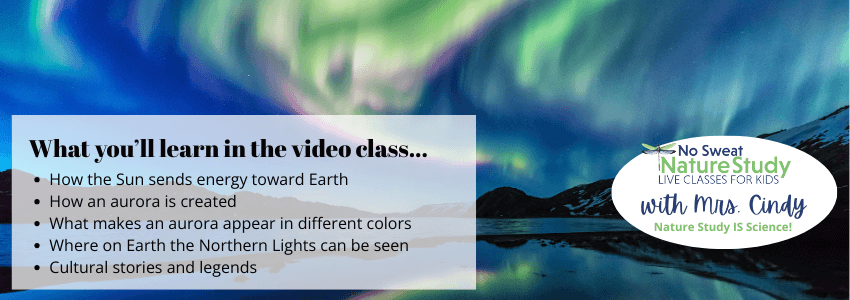
The Northern Lights video class inside the No Sweat Nature Study membership helps students understand how the aurora forms. In this class, children learn how energy from the Sun interacts with Earth’s atmosphere and magnetic field to create the glowing waves of color we call the Northern Lights. Students also create a colorful nature journal page that illustrates the aurora while labeling important parts of Earth’s atmosphere.
Families can also experience a full No Sweat Nature Study lesson through the FREE video class about symbiosis. This lesson shows how our classes combine meaningful nature-based learning with creative nature journaling. The free class and full membership details are available at NoSweatNatureStudy.com.
Free Nature Observation Printable Packet for All Seasons
The No Sweat Nature Study Podcast community has been sharing recommendations of excellent nature-themed books. Click here to find a compilation of listener favorites!
Would you like to record a voicemail to answer this season’s nature study question?
At the end of each No Sweat Nature Study Podcast episode, Mrs. Cindy includes messages from a few of her friends. You can record a message that she might use on an upcoming episode!
All children must have their parents’ permission before leaving a recording. Parents are welcome to record an answer, too!
Each season, there will be a different question to answer. You can see this season’s question below. Think about your answer first, and then follow these simple directions:
- Click the “Start recording” button.
- Tell me your first name. (If you want to tell your age and/or where you live, feel free to do that.)
- You will have 60 seconds to answer the question, but try to be concise.
- Push the play button to listen to your recording before sending it, to ensure it is recorded correctly. If not, record it again.
Please leave a rating or a review on your podcast app! It helps the podcast to show up for more people…which means more families can enjoy science through the wonderful lens of nature study! Thank you!
Make Science Meaningful and Fun
Experience a free No Sweat Nature Study class to see how easy and engaging science can be.
Kid-friendly science through the lens of nature study
Creative nature journaling with every lesson
Flexible and fun for the whole family