
Can animals and plants tell when the moon is full?
Have you ever noticed how bright a full moon can feel, especially when you’re outside at night? In this full moon nature study, we’re taking a closer look at how the changing light of the moon might affect the living things around us. From shifting shadows to brighter nighttime skies, the full moon gives us a simple way to observe patterns in nature right from our own backyard.
In this episode of the No Sweat Nature Study Podcast, we’re talking about what happens when the night gets a little brighter. Some animals change how they move or where they go, simply because it’s easier to be seen. And then there’s the big question people have wondered about for a long time… could plants be affected, too?
Full Moon Nature Study
Use these questions after listening to help your child recall what they heard and think a little more deeply about it. They also make a great starting point for a simple nighttime observation or a follow-up nature walk the next day.
- Why does the Moon look different from night to night? (Because we see different amounts of sunlight reflected off the Moon as it moves around Earth.)
- What is a full moon? (It’s when we can see the entire sunlit side of the Moon from Earth.)
- Does the Moon make its own light? (No, it reflects light from the Sun.)
- How does a full moon change the amount of light at night? (It makes the night brighter, creating faint shadows and making it easier to see.)
- How do small prey animals often respond to brighter, full-moon nights? (They stay closer to cover, pause more, or move less to avoid being seen.)
- How might predators benefit from a full moon? (The extra light can help them see and find prey more easily.)
- Why is it harder to notice how plants respond to the Moon? (Because plants don’t move, and any changes are not easy to see right away.)
- What is the Farmer’s Almanac known for including about the Moon? (It includes planting ideas and calendars that are sometimes based on the Moon’s phases.)
Full Moon Video Science Class
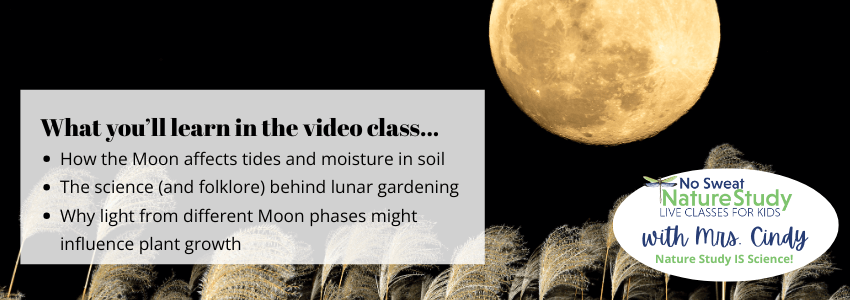
Take this topic further in the No Sweat Nature Study video class designed for 1st–8th graders. Students learn about the phases of the moon, how plants respond to light, and how to think through whether moonlight could play a role.
During the class, students create a nature journal page as they go, sketching the moon’s phases and adding simple notes to help them process what they’re learning. It gives them something meaningful to look back on and a clear way to connect what they hear to what they observe outside.
Free No Sweat Nature Study Class
If you’d like to see how these classes work, try a free No Sweat Nature Study sample class all about symbiosis. It’s an easy way to experience the teaching style, see how nature journaling fits in, and decide if it’s a good fit for your family.
Would you like to record a voicemail to answer this season’s nature study question?
I would love to hear from you! Please visit the main podcast page. Scroll down to the bottom to find this season’s question and the easy-to-use voice recorder.
Please leave a rating or a review on your podcast app! It helps the podcast to show up for more people…which means more families can enjoy science through the wonderful lens of nature study! Thank you!
Make Science Meaningful and Fun
Experience a free No Sweat Nature Study class to see how easy and engaging science can be.
Kid-friendly science through the lens of nature study
Creative nature journaling with every lesson
Flexible and fun for the whole family
the podcasts are great!