
Why do waterfalls make so much noise?
Waterfalls are powerful, beautiful, and impossible to ignore, but have you ever stopped to wonder why they are so loud? In this episode’s waterfall nature study, we explore the science of that deep, steady roar. From smoothly flowing streams to crashing plunges, you will discover how turbulence, trapped air, impact, and echo work together to create one of nature’s most dramatic sounds.
Along the way, it introduces key concepts like laminar flow and turbulence, helping kids understand how motion and energy become sound. Whether you have stood beside a roaring waterfall or simply watched one from a distance, this episode invites you to listen more carefully and notice the science happening in every drop.
Waterfall Nature Study
Parents, use these simple questions after listening to the episode to help your children recall key ideas and talk through the science in their own words.
- What is a waterfall? (Water flowing over a noticeable drop in elevation)
- What is the difference between a cascading waterfall and a plunging waterfall? (A cascading waterfall stays connected to the rock, while a plunging waterfall separates from the rock and falls freely through the air.)
- What scientific word describes smooth, stable layers of moving water? (Laminar flow)
- What scientific word describes the chaotic, churning movement of water in a waterfall? (Turbulence)
- What happens at the base of a waterfall when the falling water hits the pool below? (The water crashes, churns violently, and traps air.)
- Why is the water at the bottom of a waterfall often white and foamy? (Because air is mixed into the water.)
- How does turbulence create sound? (The violent churning and collisions create continuous vibrations, and vibrations are what we hear as sound.)
- Why can a waterfall inside a canyon sound louder than one in an open space? (The sound waves bounce off the rock walls and overlap, making the roar seem deeper and louder.)
Waterfall Nature Study Video Class
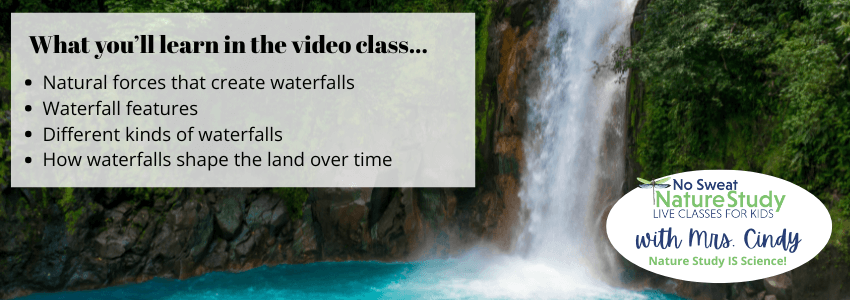
In the companion video class, we take a closer look at how waterfalls form and how they continue shaping the land over time. First through eighth graders explore how gravity, erosion, and rock type shape waterfalls as they learn about features such as plunge pools, cascades, and gorges. The lesson includes a guided nature journaling page to help students observe and label the parts of a waterfall.
If you would like to try a class before joining, a free symbiosis sample lesson is available. It offers a simple look at how No Sweat Nature Study combines clear science instruction with meaningful nature journaling.
Would you like to record a voicemail to answer this season’s nature study question?
At the end of each No Sweat Nature Study Podcast episode, Mrs. Cindy includes messages from a few of her friends. You can record a message that she might use on an upcoming episode!
All children must have their parents’ permission before leaving a recording. Parents are welcome to record an answer, too!
Each season, there will be a different question to answer. You can see this season’s question below. Think about your answer first, and then follow these simple directions:
- Click the “Start recording” button.
- Tell me your first name. (If you want to tell your age and/or where you live, feel free to do that.)
- You will have 60 seconds to answer the question, but try to be concise.
- Push the play button to listen to your recording before sending it, to ensure it is recorded correctly. If not, record it again.
Please leave a rating or a review on your podcast app! It helps the podcast to show up for more people…which means more families can enjoy science through the wonderful lens of nature study! Thank you!
Make Science Meaningful and Fun
Experience a free No Sweat Nature Study class to see how easy and engaging science can be.
Kid-friendly science through the lens of nature study
Creative nature journaling with every lesson
Flexible and fun for the whole family