
Why Do Some Animals Seem So Smart? A Podcast for Kids
Animals appear in stories all the time, often talking, thinking, and teaching lessons. In this episode of the No Sweat Nature Study Podcast, children will explore animal intelligence through an Aesop’s Fables nature study. From clever crows to dolphins that understand hand signals, listeners will learn how to distinguish between instinct and learned behavior.
The episode also explores how fables use personification to teach morals and how real animal traits sometimes reflect those same lessons. It blends storytelling with science in a way that helps kids see animals in a whole new light.
Aesop’s Fables in Nature Nature Study
These questions are a simple way to encourage thoughtful narration, spark meaningful discussion, or check for understanding after listening to the episode. You may use them in conversation, in a nature notebook, or as part of a gentle review. Complete sentence answers are wonderful, but natural conversation is just as valuable.
- What was the barn cat doing that led Mrs. Cindy to think it seemed intelligent?
(It was creeping slowly across the yard, focused like it had spotted prey.) - What is instinct, and can you give an example from the episode?
(Instinct is something animals are born knowing how to do, like spinning a web or migrating.) - What does it mean when we say an animal shows intelligence?
(It means the animal learns from experience, solves problems, or remembers things.) - How do crows use tools to solve problems?
(They’ve been seen dropping pebbles into water to raise the level and reach floating food.) - What can dolphins understand and remember?
(They can remember people’s faces and follow hand signals to do things like spin or jump.) - What is a fable?
(A fable is a story where animals act like people, and it ends with a moral or lesson.) - What is personification, and how is it used in fables?
(Personification is when animals are given human traits like talking or making decisions.) - How is a real animal different from a character in a fable?
(Real animals act in ways that help them survive, not to teach lessons or be sneaky on purpose. Their sneakiness is a survival tool called an adaptation.)
Aesop’s Fables in Nature Nature Study Video Class
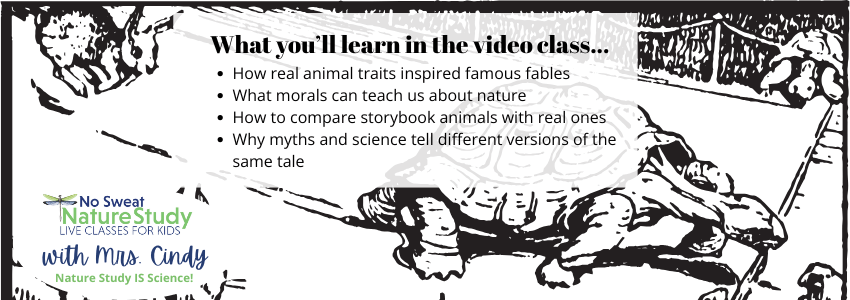
There’s a special companion No Sweat Nature Study video class that continues the fun of this podcast episode. During the lesson, 1st-8th graders take a closer look at some of Aesop’s most familiar fables and discover how real animal behaviors reflect the morals those stories teach. With guided discussion, sketching opportunities, and a bit of scientific wonder, the class brings both fables and nature to life.
This class is part of the full No Sweat Nature Study membership, which includes nearly 200 engaging video lessons designed to make science meaningful through nature. Come learn alongside Mrs. Cindy this semester!
Free Nature Observation Printable Packet for All Seasons
The No Sweat Nature Study Podcast community has been sharing recommendations of excellent nature-themed books. Click here to find a compilation of listener favorites!
Would you like to record a voicemail to answer this season’s nature study question?
At the end of each No Sweat Nature Study Podcast episode, Mrs. Cindy includes messages from a few of her friends. You can record a message that she might use on an upcoming episode!
All children must have their parents’ permission before leaving a recording. Parents are welcome to record an answer as well.
Each season, there will be a different question to answer. You can see this season’s question below. Think about your answer first, and then follow these simple directions:
- Click the “Start recording” button.
- Tell me your first name. (If you want to tell your age and/or where you live, feel free to do that.)
- You will have 60 seconds to answer the question, but try to be concise.
- Push the play button to listen to your recording before sending it, to ensure it is recorded correctly. If not, record it again.
Please leave a rating or a review on your podcast app! It helps the podcast to show up for more people…which means more families can enjoy science through the wonderful lens of nature study! Thank you!
Make Science Meaningful and Fun
Experience a free No Sweat Nature Study class to see how easy and engaging science can be.
Kid-friendly science through the lens of nature study
Creative nature journaling with every lesson
Flexible and fun for the whole family