Posted by Cindy on January 2, 2009
I meant to put this post up before Christmas break – oops!
I hope you aren’t getting bored with all the fun math we’ve been doing from Hardhatting in a Geo-World. I just can’t help sharing what has been a GREAT math & science unit! If you are getting bored, you’ll be glad to know this is the last post!
The other posts can be found here and here.
We did one last lesson on bridges. This demonstrated the importance of strong anchors for a suspension bridge to be strong. (Yes, that’s our art table. We needed to place thumbtacks somewhere and the art table did the job. Yes, those are baby feet standing on the art table. He wants to be part of every activity we do!)


We also did a couple of thought-provoking activities concerning geometric shapes. Do you know if you’re a square, tall rectangle or short rectangle? We do! Just measure your height and arm span to find out. Equal measurements mean you are a square. Longer height than arm span makes you a tall rectangle, while shorter height than arm span makes you a short rectangle.


And this activity involved predicting shapes when circles were attached and cut in various ways.

As of January 5th, we’re back on our regular math schedule – three days per week of textbook, two days of living math/problem solving/logic. I’ll continue to share living math ideas, but they won’t come quite as frequently. Until then, happy math lessons!
Posted by Cindy on October 29, 2008
It was COLD in Central KY yesterday. The nature walk part of our study was rather short – a quick trip down to the creek bed to collect a variety of leaves. But once we got home – the learning and fun began!
We started with a review discussion about the purpose of leaves and why they change colors. After a bit of struggle getting everyone to pay attention during the discussion, I announced there would be a test later in the day. (Yep, that meant I had to come up with some sort of test on leaves! In all that spare time I have, you know. Lucky for me, I was able to find this quiz online.) I don’t do tests very often, but it was just the thing needed today to turn their attention back toward our discussion.
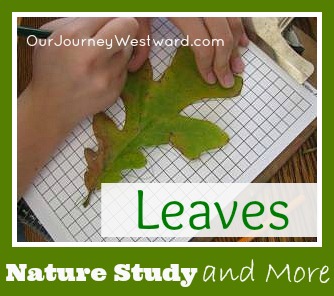
Math was next on the list. Using a few of the leaves each, the kids had to find the perimeter of the leaves in inches and centimeters. Then had to find the area in square inches, square centimeters and an unknown square unit. Yarn and a measuring tape made finding the perimeter easy.

The area in square inches was found using one-inch tiles. A one-inch grid could be used as well.

We used centimeter grid paper for finding the area in square centimeters. (Simply trace the leaf and count the full squares inside the leaf. We estimated the half and quarter filled squares to add more area. For instance, if there were two halves, we would count them as one. If there was a square about 3/4 full and another 1/4 full, we combined them as one.)

Graph paper was used to find an unknown square unit. We talked about smaller units making for more accurate measurements.
Finally, we created leaf burst for an art activity to add to the nature notebooks.


Enjoy even more fun with leaves and trees by using: