subscribe to the RSS Feed

Wednesday, May 23, 2012

Nature Study – Leaves

Posted by Cindy on October 29, 2008

It was COLD in Central KY yesterday.  The nature walk part of our study was rather short – a quick trip down to the creek bed to collect a variety of leaves.  But once we got home – the learning and fun began!

We started with a review discussion about the purpose of leaves and why they change colors.  After a bit of struggle getting everyone to pay attention during the discussion, I announced there would be a test later in the day.  (Yep, that meant I had to come up with some sort of test on leaves!  In all that spare time I have, you know.  Lucky for me, I was able to find this quiz online.)  I don’t do tests very often, but it was just the thing needed today to turn their attention back toward our discussion.

Math was next on the list.  Using a few of the leaves each, the kids had to find the perimeter of the leaves in inches and centimeters.  Then had to find the area in square inches, square centimeters and an unknown square unit.  Yarn and a measuring tape made finding the perimeter easy.

The area in square inches was found using one-inch tiles.  A one-inch grid could be used as well.

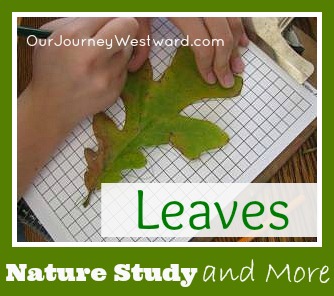
We used centimeter grid paper for finding the area in square centimeters.  (Simply trace the leaf and count the full squares inside the leaf.  We estimated the half and quarter filled squares to add more area.  For instance, if there were two halves, we would count them as one.  If there was a square about 3/4 full and another 1/4 full, we combined them as one.)

Graph paper was used to find an unknown square unit.  We talked about smaller units making for more accurate measurements.

Finally, we created leaf burst for an art activity to add to the nature notebooks.

Enjoy even more fun with leaves and trees by using:

Photobucket

Autumn Living Math

Posted by Cindy on October 16, 2008

Remember Mathwire?  Boy, do they have some goodies for the fall season!  Below are some of the activities we’ve done so far.

Scarecrow Measurement Man

Candy Corn Triangular Number Pattern

Insect and Spider Problem Solving

And these are on our to-do list….

~Area and Perimeter of Leaves

~Coordinate Graph Jack-o-lantern

Go have some fun with math this month!

President’s Day Math

Posted by Cindy on February 27, 2008

I just wanted to share what a hit this math activity was last week.

Using the information sheets that the website provides, the kids had to fill out a chart to show how many presidents have come from which states.  Then, they used graph paper to create a bar graph to show the information from the chart.  Fun activity!

Living Math – Winter Fun

Posted by Cindy on February 4, 2008

After the last couple of living math posts, I promised to share some of our non-textbook lessons.  Here are some of the fun things we’ve been doing/have planned to do this winter on our living math days.  My hope is to encourage you that….

1.) Living math really is thoughtful, meaningful math.

2.) Living math isn’t hard to implement at all.

Here are a few of our January/February activities with links…

This Grab the Candy Game allows the kids to practice coordinate graphing and record keeping.  Valentine Battleship is another version of a coordinate graphing game.

How Many Different Ways Can You Make the Word Snow? is a quick activity to encourage problem solving and critical thinking.  This Heart Paths sheet is similar, but requires an extra “rule” to make the kiddos think a bit harder.

These Candy Heart Patterns are a little harder than they first seem.  I gave these to my 5th grader as “fun filler” and she realized half-way through that she hadn’t thought the pattern through completely!

Glyphs are pictures children make based on a legend or key of codes.  Not only does it reinforce problem solving, critical thinking and organization skills, but mapping as well.  Here’s a link to the Snowman Glyph activity we used.

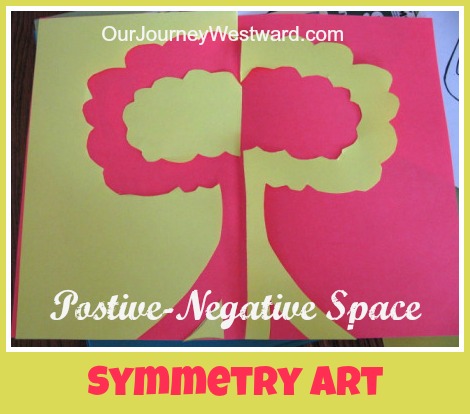
These Symmetrical Heart Masks reinforced the concept of symmetry, as well as creativity.

This President’s Day activity is going to require charting and creating a graph.

Even this worksheet of Valentine Word Problems is a fun, seasonal way to change the pace from a textbook.

There are a few more activities we’ve done or have planned to do, but I’ll let you find them for yourself at MathWire – an awesome site for living math ideas!

When the activities are quick, I’ll do several in one day.

As for living literature, we’ve checked out this series of books from the library to go along with our Medieval Unit.

Learn more about adding living math to your homeschool with Loving Living Math!

I’d love to hear about your living math learning!  If you share on your blog, please let me know so I can come visit!  Happy math times!

Living Math

Posted by Cindy on January 5, 2008

I hated math when I wad a kid.  Hated it.  It didn’t make much sense to me, I had a hard time memorizing facts, and my teacher’s didn’t spend much time helping me to understand.  I used to nearly have anxiety attacks in middle school when the teacher put this sort of problem on the board.  “If a train from NY is traveling 60 mph……”  You probably didn’t care much for those problems either, did you?  :)

I remember my poor Dad spending countless hours trying to teach the concept of fractions to me in third grade, only to have every lesson end in tears and me leaving the table saying, “I just don’t get it!”  Surprisingly, I made very good grades in spite of the disdain for math.  And even though I hated every minute of it, I survived.

Fast forward to my early twenties when I started teaching.  What was one of the subjects I had to teach?  Math!  But, I wasn’t afraid.  I could handle elementary math, couldn’t I?  Imagine my surprise (and my Dad’s) when math actually became one of my favorite subjects to teach!!  You see, I had learned to teach with manipulatives, something my teachers had never given me.  What a difference it made!  I was finally able to understand fractions AND I was able to teach someone else to understand them!  Wow!

So, needless to say, I’m a big believer in teaching math with manipulatives.  There’s a connection made in the brain that allows children (and adults) to “see” math and to understand the why’s of math rules.  I believe teaching math with manipulatives is a key element to making math a living subject. And just why would math need to be a living subject?  The same reason we try to make history or science living subjects – because “living” subjects draw people in.  They give a relevance to learning that means more than facts on paper.  They make heart and mind connections so that we hopefully love what we’re learning.  And they give whole pictures of a topic so the “pieces” fit together better.

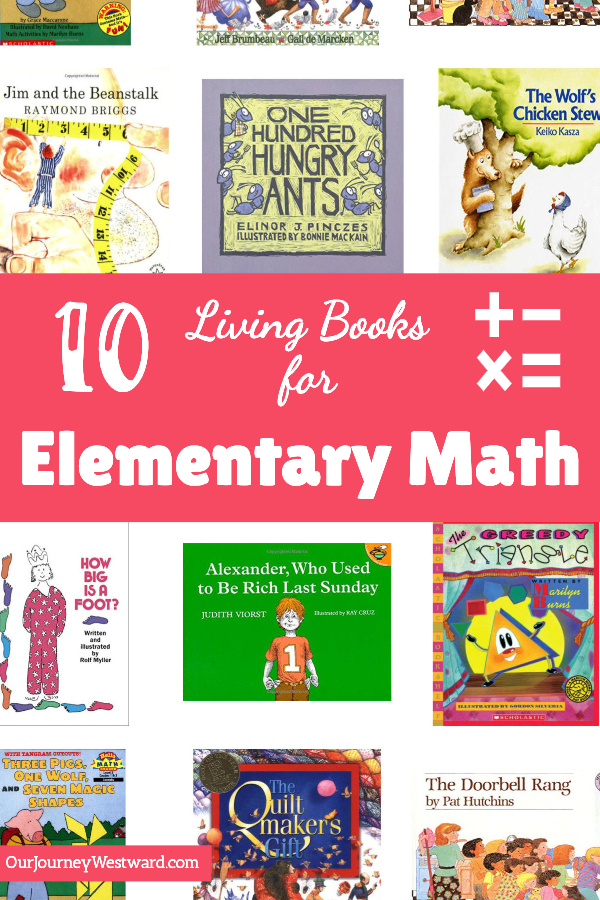
Besides manipulatives, what else makes math living?  A Charlotte Mason education certainly includes good books, right?  Math can include living books, too!   There is so much wonderful math literature out there!  I’ve started a  small library for myself (some of which I pictured below),  but most of the books we’ve used have been easy to find at our library.  Below are three websites that list many titles you might like to check out.

My favorite living literature for math lessons can be found here.

Including literature during a math lesson is very easy.  I wrote a post not too long ago about using One Grain Of Rice: A Mathematical Folktale for a lesson in doubling numbers.  Some other very simple ideas would be…

  • Reading How Big Is a Foot? and comparing measurements based on your feet and your child’s feet.  Then talking about the necessity of a standard unit of measurement.

The ideas are endless, but well worth the thought  because your children will thrive on such exciting activities.  The greatest part is that you probably don’t have to really work that hard.  Doing a Google search on “(name of book) activities” will most likely place activity ideas right in front of you.  Here are some great websites to get you started.

Mathwire Literature Connections

NCTM Ideas

Linda’s Learning Links

For many, many more ideas about how to add living math lessons to your homeschool, check out Loving Living Math!

May you and your children find math to be exciting and worthwhile!  I would love to hear some of your favorite math books and how you used them in your homeschool!!