Posted by Cindy on October 31, 2008
We’re finishing up our Thirteen Colonies & Colonial Life Unit this week! I’ll be posting soon about the biggest chunk of the unit, but I wanted to take a minute to highlight the 13 Colonies lapbook/notebook we put together using:


I had to do the legwork of locating library books about each of the Thirteen Colonies, as well as Roanoke, Jamestown and Plymouth. But the wonderful activity ideas were ready and waiting in the book. It turned out to be a lovely way to document a bit of info on each of the colonies we learned about.
Posted by Cindy on October 30, 2008
I promised to show you some of the fun things we’re doing as we go through Christian Kids Explore Chemistry
. I can’t brag enough about this curriculum so far. I don’t typically follow any curriculum to a “T” – but this one I am. It is teaching my children things that I didn’t learn until high school in very understandable terms. How many third graders do you know who can tell you all the parts to an atom and make a labeled model? It makes me smile!
Lithium model

Labeled carbon atom

Hydrogen and Carbon atom cookies

Posted by Cindy on October 29, 2008
It was COLD in Central KY yesterday. The nature walk part of our study was rather short – a quick trip down to the creek bed to collect a variety of leaves. But once we got home – the learning and fun began!
We started with a review discussion about the purpose of leaves and why they change colors. After a bit of struggle getting everyone to pay attention during the discussion, I announced there would be a test later in the day. (Yep, that meant I had to come up with some sort of test on leaves! In all that spare time I have, you know. Lucky for me, I was able to find this quiz online.) I don’t do tests very often, but it was just the thing needed today to turn their attention back toward our discussion.
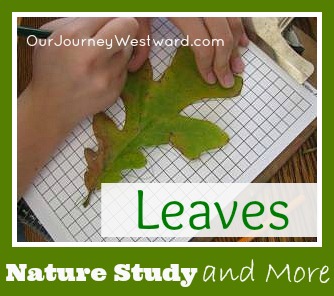
Math was next on the list. Using a few of the leaves each, the kids had to find the perimeter of the leaves in inches and centimeters. Then had to find the area in square inches, square centimeters and an unknown square unit. Yarn and a measuring tape made finding the perimeter easy.

The area in square inches was found using one-inch tiles. A one-inch grid could be used as well.

We used centimeter grid paper for finding the area in square centimeters. (Simply trace the leaf and count the full squares inside the leaf. We estimated the half and quarter filled squares to add more area. For instance, if there were two halves, we would count them as one. If there was a square about 3/4 full and another 1/4 full, we combined them as one.)

Graph paper was used to find an unknown square unit. We talked about smaller units making for more accurate measurements.
Finally, we created leaf burst for an art activity to add to the nature notebooks.


Enjoy even more fun with leaves and trees by using:
Posted by Cindy on October 25, 2008

We live in Central KY – what’s often called the ”Horse Capital of the World”. We’re surrounded by beautiful horse farms and have the priviledge of living near the Kentucky Horse Park. With so much horse business going on in the area, there are two premier equine hospitals within easy driving distance. Lucky for us, Rood and Riddle Equine Hospital agreed to give us a tour of their amazing facilities. Horses that are worth millions have state-of-the-art hospitals with every just about everything you might expect in a hospital for people – surgery suites, recovery rooms, MRI machines, laboratories, pharmacies….
Here are just a few pictures from our day.

Doctors, nurses, interns and visiting vet students preparing for an emergency colic surgery. All the surgery suites have viewing windows. Since colic surgery is one of their messiest, they closed the blinds once the cutting began.

A doctor, ultrasound technician, horse hand and owner are looking at an ultrasound of this horse’s throat.

The x-ray reading room.

A healing horse.

The farrier’s shop where custom horse shoes and such are made.

The treadmill.
If you’re interested, they have an online tour here. This really was an amazing trip!
Posted by Cindy on October 22, 2008
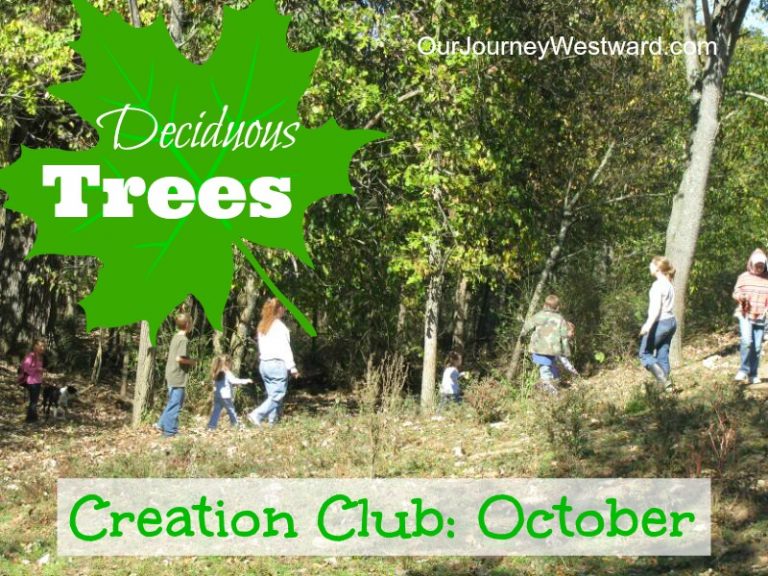
Our Creation Club met for the last time until spring. (Boo Hoo) This month’s focus was on trees and we were as busy as beavers!

As a warm-up activity, each child was asked to find a leaf from any tree in the area. They had to remember which tree it came from! Then, they exchanged leaves with someone and had to located the tree their new leaf came from. The partners worked together to give hints to each other if needed.

I gave a simple explanation of why leaves change colors in the fall while the kids took notes on a notebooking page.

Then, we played a game to warm up their detail finding skills. Everyone teamed up in partners again. The first partner had to close their eyes, while the second partner led them to a tree. With eyes still closed, the first partner had to touch the tree remembering as much detail as possible. The first partner then led them back to the starting point with eyes still closed. The first partner then had to try to locate the tree with eyes open. Fun!

Now the kids were ready to “adopt” a tree. Using a notebooking page from Considering God’s Creation, they had to notice all sorts of things about their tree such as bark style, tree shape, leaf type, leaf shape and more. On the back of this page, I added a few more things for them to do like measuring the circumference of the trunk, tracing a leaf and coloring in detail, sketching something they found using a magnifying glass and such. You can download this simple page here.

Using watercolors, they had to paint a picture of their tree. We used our imaginations a bit since the drought has really caused all of our trees to lose their brilliant colors already.

Then, they were asked to take a few quiet minutes to write a poem about their tree or a prayer to God in thanksgiving of trees.

Finally, we took a short walk to some tree stumps to see if we could figure out the age of any of the trees that were once there by counting the rings.

This was two hours of our day that were definitely not wasted! Thank you , God, for your glorious creation!
Learn how to create your own wonderful tree study using: