Living Math
(This post contains affiliate links and links to my business website, Shining Dawn Books.)
I hated math when I wad a kid.
Hated it. It didn’t make much sense to me, I had a hard time memorizing facts, and my teacher’s didn’t spend much time helping me to understand.
I remember my poor dad spending countless hours trying to teach the concept of fractions to me in third grade, only to have every lesson end in tears and me leaving the table saying, “I just don’t get it!” Surprisingly, I made very good grades in spite of the disdain for math. And even though I hated every minute of it, I survived.
Me, teach math??
Fast forward to my early twenties when I started teaching. What was one of the subjects I had to teach? Math! But, I wasn’t afraid. I could handle elementary math, couldn’t I?
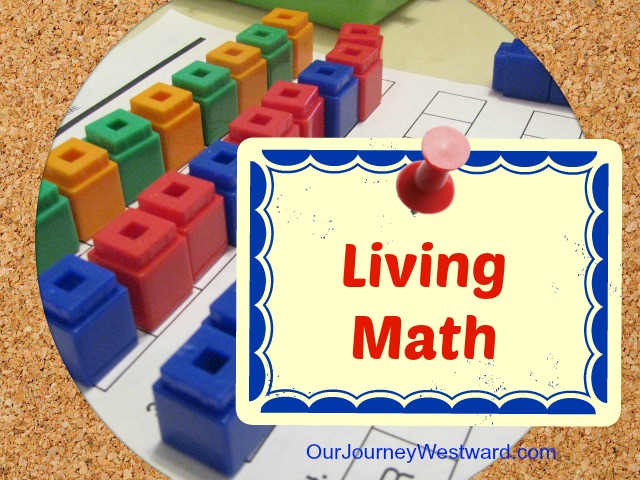
Imagine my surprise (and my dad’s) when math actually became one of my favorite subjects to teach!! You see, I had learned to teach with manipulatives, something my teachers had never given me. What a difference it made! I was finally able to understand fractions AND I was able to teach someone else to understand them! Wow!
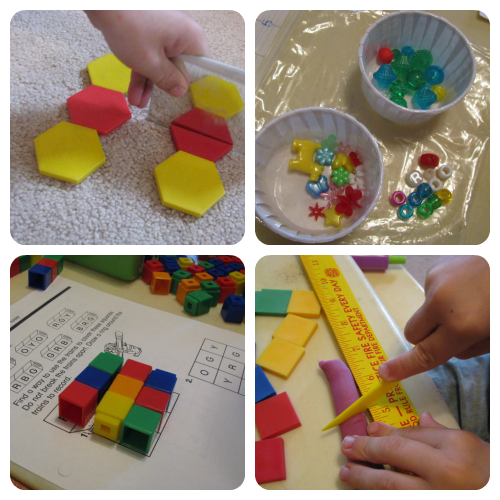
I’m a big believer in teaching math with manipulatives!
There’s a connection made in the brain that allows children (and adults) to “see” math and to understand the why’s of math rules. I believe teaching math with manipulatives is a key element to making math a living subject.
And just why would math need to be a living subject? The same reason we try to make history or science living subjects:
- Living subjects draw people in.
- They give a relevance to learning that means more than facts on paper.
- They make heart and mind connections so that we hopefully love what we’re learning.
- They give whole pictures of a topic so the “pieces” fit together better.
Besides manipulatives, what else makes math living?
A Charlotte Mason education certainly includes good books, right? Math can include living books, too! There is so much wonderful math literature out there! I’ve started a small library for myself (some of which I pictured below), but most of the books we’ve used have been easy to find at our library. Below are three websites that list many titles you might like to check out.
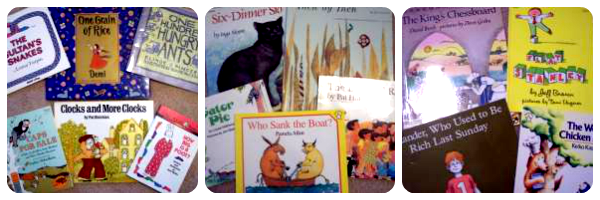
My favorite living literature for math lessons can be found here.
Including literature during a math lesson is very easy.
I wrote a post not too long ago about using One Grain Of Rice: A Mathematical Folktale for a lesson in doubling numbers. Some other very simple ideas would be…
- Read One Hundred Hungry Ants
 – use manipulatives to make fair shares
 - Read How Big Is a Foot? – compare measurements based on your feet and your child’s feet then talk about the necessity of a standard unit of measurement
- Reading Alexander, Who Used to Be Rich Last Sunday – work on a skill like money subtraction with real coins
 – use manipulatives to make fair shares
 –
–  – work on a skill like money subtraction with real coins
The ideas are endless, but well worth the thought because your children will thrive on such exciting activities. The greatest part is that you probably don’t have to really work that hard. Doing a Google search on “(name of book) activities” will most likely place activity ideas right in front of you. Here are some great websites to get you started.
Mathwire Literature Connections
Need More Living Math Info?
For many, many more ideas about how to add living math lessons to your homeschool, check out my book, Loving Living Math!

May you and your children find math to be exciting and worthwhile! How do you make math living?
Incorporate Living Math in Your Homeschool
Manipulatives and books are just the beginning of living math. In the Living Math Video Training and Loving Living Math book you will learn how to incorporate other forms of living math into your homeschool. With these fun ideas your kids will actually look forward to math!
-

-
Product on saleLoving Living Math$15.00